Mini Review – milk and honey by Rupi Kaur

31-oDaA7eRL._SX322_BO1,204,203,200_

blue5 (2)

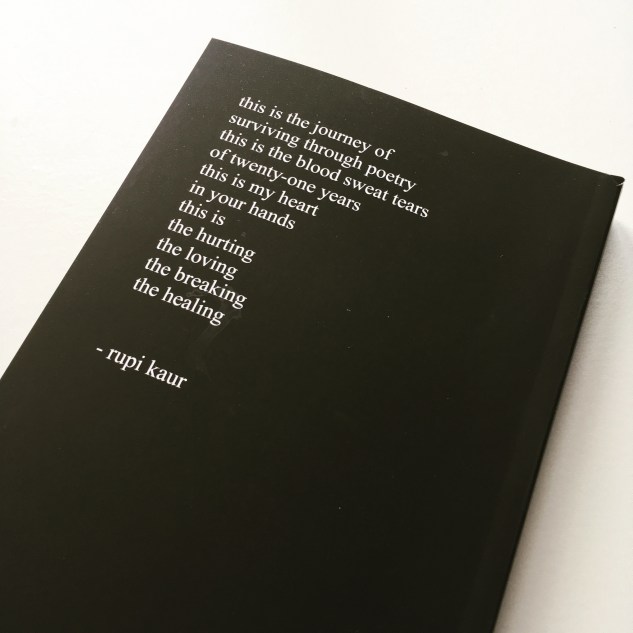
milk and honey is a collection of poetry and prose about survival. About the experience of violence, abuse, love, loss and femininity. It is split into four chapters, and each chapter serves a different purpose.

Rupi Kaur has achieved a mean feat with this book – it is the first and only book of poetry I have read from start to finish. It captivated me. It was effortless, unapologetic, strong, feminist and empowering.

IMG_1626

It is extremely difficult to try and review this book because every single poem is so personal, and tender, and significant in its own unique way. If you only read one book of poetry in your entire life, I urge you to read this one. It is such a sad, amazing and heartbreaking little book. It touches on all aspects and potential experiences of womanhood, through the form of a break-up – abuse, femininity, inner strength, insecurity, love, and grief.

‘You have sadness living in places sadness shouldn’t live.’

Rupi Kaur’s words are written for her – this is obvious in every line, every utterance, every chapter of the book, as her poetry develops and grows and heals and remembers. But it also manages to make you feel something powerful yourself – her stories are amazingly relateable, and her poetry is addictive, thought-provoking, and very, very personal.

IMG_1629

My 3 Favourite Books About Feminism

A Room of One's OwnA Room of One’s Own by Virginia Woolf

‘When, however, one reads of a witch being ducked, of a woman possessed by devils, of a wise woman selling herbs, or even of a very remarkable man who had a mother, then I think we are on the track of a lost novelist, a suppressed poet, of some mute and inglorious Jane Austen, some Emily Bronte who dashed her brains out on the moor or mopped and mowed about the highways crazed with the torture that her gift had put her to. Indeed, I would venture to guess that Anon, who wrote so many poems without signing them, was often a woman.’

Every single woman should read this. I originally read it whilst studying for my Literature degree, and as a writer myself, it struck a chord and her words have stayed with me, always. It is the essence of Virginia Woolf herself, and I turn to it when I feel rejected, downtrodden, or if I begin to doubt that my work is good enough. This is Woolf’s homage to the spirit of heroines in history who may have written poems, novels, plays, stories, songs and ballads but were forced to remain anonymous as it was unacceptable for women to write. What if Shakespeare had an equally talented sister, but she could never have been as successful as Shakespeare himself because she was a woman, and woman were not allowed to write? She ends the essay by urging women and men to pick up their pen and write, and to banish the limits of gender identity and write with an androgynous mind instead.

the equality illusionThe Equality Illusion by Kat Banyard

Women have made huge strides in equality over the last century. And feminism is now generally considered irrelevant, or old-fashioned, or even embarrassing. But what about the fact that today women working full-time in the UK are paid on average 17% less an hour than men? That one in three women worldwide has been beaten, coerced into sex, or otherwise abused because of her gender?

This book is a few years old now, but is still one of the best books I’ve read about feminism today and the history of. The statistics and research are solid, and it explores the position of women in the UK in areas such as education, work, domestic violence, body image, sex and abortion rights. It’s entirely relevant and written concisely, cleverly and clearly. It’s a really good read, especially if you’re new to identifying as a feminist. It’s a great starter book and Banyard explains everything from grassroots feminism to current day, and how basically every single area of women’s lives are still affected by casual, deep-seated sexism. It’s the perfect book to get you really thinking about modern day feminism, and makes you realise that sexism is not dead. Banyard describes this idea that sexism no longer exists in our society as the ‘Equality Illusion’. This book is an invaluable feminist manifesto for the women of today.

SIsterhood InterruptedSisterhood Interrupted by Deborah Siegel

Contrary to clichés about the end of feminism, Deborah Siegel argues that younger women are reliving the battles of its past, and reinventing it–with a vengeance. From feminist blogging to the popularity of the WNBA, girl culture is on the rise. A lively and compelling look back at the framing of one of the most contentious social movements of our time, Sisterhood, Interrupted exposes the key issues still at stake, outlining how a twenty-first century feminist can reconcile the personal with the political and combat long-standing inequalities that continue today.

I found this book hugely helpful in sorting out all the confused and conflicting stereotypes I may have absorbed about feminism. It’s a great summary of second and third wave feminism and it gave me the knowledge to confidently explain the history of feminism to those who question the word and what it means. It lays out the history of the movement, covering the important events of the 60’s and 70’s, and continuing to present day. The most important thing I learned from this book is that feminism has never been a single, united force as some believe. It explains the entirety of the issues that have existed within feminism itself – the internal conflict over which fights are worth fighting, the best methods to coerce change, and what feminism actually means. There is no one type of feminism, and it isn’t about one single point of view all women who claim the label ‘feminist’ share. This book really teaches you that there are many different kinds of feminism, and that it’s okay to find your own place within the movement.

Book Review – Suffragette: My Own Story

91g6rkawY9L._SL1500_

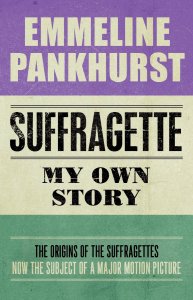
Suffragette: My Own Story by Emmeline Pankhurst
Published: in 2015 by Hesperus Press Limited (First Published in 1914)
Genres: Autobiography, Feminism, Politics
Pages: 332
Source: Goodreads

blue5 (2)

The closing paragraphs of this book were written in the late summer of 1914, when the armies of every great power in Europe were being mobilised for savage, unsparing, barbarous warfare-against one another, against small and unaggressive nations, against helpless women and children, against civilisation itself. How mild, by comparison with the despatches in the daily newspapers, will seem this chronicle of women’s militant struggle against political and social injustice in one small corner of Europe. Yet let it stand as it was written, with peace-so-called, and civilisation, and orderly government as the background for heroism such as the world has seldom witnessed. The militancy of men, through all the centuries, has drenched the world with blood, and for these deeds of horror and destruction men have been rewarded with monuments, with great songs and epics. The militancy of women has harmed no human life save the lives of those who fought the battle of righteousness. Time alone will reveal what reward will be allotted to the women.

I think the most powerful aspect of this story, which is part history, part politics and part autobiography is that it was written before the battle for women’s votes was won. The effect on the reader is that you come close to feeling like a real-time participant in the battle between the WSPU and the government. The detail is revealing and the facts are shocking. Before reading this book, I believed I was clued up on the Suffragette movement, but clearly I was not. I had no idea of the full goriness, pain, barbarism at the hands of men and utter unfairness that the women of the WSPU had to endure. They were incredibly brave and it humbles me. Pankhurst’s writing is fully immersive and you feel as though you are right in the middle of it, witnessing the events that she describes transpire.

Although it was written a hundred years ago, and we now have the vote that they were fighting for, the whole story still feels entirely relevant. We might have the vote, here in the UK, but there are still women who do not use it, and there are still millions of other battles that we need to fight to ensure an equal society. Every woman in the UK should read this, especially as we approach a general election, in which we will all get the right to vote on who runs our country. We’re a long way from equal representation, and I still speak to women who have never voted and do not intend to vote, which makes me angry. I do have a tendency to over-preach my views, but still. Women endured barbaric suffering and even died so that we could have the vote – and you’re not going to use it? Seriously?

I was brought up by a mother who taught me everything that she knew about the suffragette movement and was always made aware that I should value my right to vote, and that women had chained themselves to railings, and endured force-feeding, on my behalf for that right. What I did not realise was the full gory detail of that fight, and how utterly barbaric it was. Emmeline Pankhurst seems to try to justify her use of militancy in the autobiography – but I do not feel she needs to. I’m unsure whether I would have been strong enough to have fought alongside them and that thought alone is humbling. It got me to thinking what I would have done as a Suffragette – how far would I have gone? And what I could continue to do now to help modern day feminist issues.

Why this book isn’t on every school history class reading list I do not know. It really, really should be. Women’s history should be just as important a part of education as male history, but it still isn’t, even now. I know for a fact that without my mother teaching me who Mrs Pankhurst was, who Emily Davison was, and what they both did, along with others, there is no way that I would have known even their names if she had left it down to my teachers.

USE YOUR VOTE is a phrase that springs to mind, especially now, with the UK General Election approaching and the country in a state of prospective political change. It has never been more important to integrate feminism into your everyday life. Even if it’s just as small as calling up a co-worker on a sexist comment, or righting ignorance. Only the other day, I was at a dinner, and we were talking about the general election. A woman sat beside me said that she wouldn’t vote, and never had, as ‘she didn’t know who to vote for.’ I couldn’t help but say ‘You have to vote. Do some research, and vote for the party you like the most. Women died so that you could have the freedom to do that.’ Subsequently, a man in the same conversation proceeded to comment that ‘They did not! All they did was burn their bloody bras!’ I felt my face boil up in anger at the ignorance of his comment, and I wish, even now, that I had had the confidence to right him.

This book has definitely given me that confidence to speak up, and I think that every woman in the world should read it. It’s enlightening, enjoyable, shocking and inspirational. And there has never been a more perfect time to read it.