It’s not you, Book, it’s me: The Dreaded Reading Slump and How To Get Over It

I think that all of us readers have been there. When you are used to reading over 4 books a month, and suddenly, you can hardly bear to read a news article, never mind a novel.

It feels like it is all down to the book. First, you pick up a terrible book, and you don’t finish it. Then, you try another. That’s awful too! And another. They are all boring – nothing grabs you. It could be fantasy, romance, historical, non-fiction, anything. It doesn’t matter. Nothing will grab you. Because it isn’t the book, it’s you.

There are many, many reasons why one might have a reading slump. Lack of motivation, time, stress, anxiety, depression… So, what do we do? We do things that do not require the same level of attention – things we can finish quickly and not think about too deeply.

YouTube, TV shows, scrolling through Facebook, binge-watching Netflix. It’s terrible, isn’t it? And for some, sure, it might be totally normal. But for readers who read (and I mean, read read read) it becomes this depressing, odd, stagnant hole in your life and makes you feel weirdly guilty and not-quite-yourself. Having just come out of the longest reading slump of my life (Not an exaggeration – it was four months long, and torturous!) I created a list of things that finally helped me to get my reading mojo back…

Start Light

I often find that reading something very easy, funny and lighthearted is sometimes the best way to get yourself back into reading. Chick-lit is a great example – it’s fun, summery, and full of simple story lines that do not require too much thinking power. I can be a bit of a snob and don’t usually enjoy chick-lit, but it works wonders for a reading slump. Just getting yourself reading again – whatever it is – is a massive achievement, and it helps if you can have a giggle along the way! Chick-lit offers a form of escapism that is rooted in reality and full of funny anecdotes, beautiful settings and swoon-worthy guys.

Paige Toon is a brilliant one to start with (The Longest Holiday is simply divine, and Lucy in the Sky and Jonny Be Good are also excellent – they are escapism at it’s best – letting you get swept up in holiday romances, gorgeous rock stars, sandy beaches and surfer dudes)

Keep It Short

Don’t feel like you are ready to plunge in to a full-length novel, just yet? That’s totally fine! Sometimes, it might hinder you rather than help you, so I would suggest starting with some shorter stories first. They pull you back into the swing of reading, but don’t keep you for too long. Short, and sweet.

A recent page-turner that comes to mind is Sarah Winman’s Tin Man. It’s a heart-warming, lovely little book that will warm you from your head to your toes – and you can read it in a day!

Try a Different Angle…

Perhaps it is the act of reading that is stopping you from breaking your slump? If you are depressed, it can become almost impossible to focus on anything for too long – you become so demotivated, you can’t even bring yourself to open the book and read the words. Listening to an audiobook, however, is a very different experience to physically reading. You can listen on the tube, on the bus, at your desk, whilst you are driving. It’s the perfect solution!

If this still isn’t helping, another great invention is the Podcast. They have honestly been my saviour the past few months – stopping me from going stir crazy when I feel like I am numbing my brain with YouTube and Netflix. There are some interesting, intelligent, fascinating Podcasts out there – everything from Literature to Science to discussions on authors, fandoms (There are some brill Harry Potter & Game of Thrones casts – Game of Thrones The Podcast is one of my favourites) and the BBC also have some great documentary style discussions on different authors and time periods. I listened to an engrossing one about one of my favourite authors, Oscar Wilde, that inspired me to re-read The Picture of Dorian Gray, hence pulling me out of my slump! Most of them are only 30 minutes upwards, so it’s entirely possible to feed your brain without committing too much time!

Switch It Up

Before your slump, were you (let’s be honest) a bit too obsessed with YA Fantasy? (It’s an easy hole to fall in to…) or did you pretty much only read Thrillers? I find one of the best ways to break a non-reading period is to get stuck into a book of an entirely different genre. It will pull you out of your comfort zone, and make you read something completely unexpected and different to anything you have read before.

Goodreads is fantastic for discovering new books from genres you are unsure about. Or, even better, just step into Waterstones, and spend a couple of hours browsing. You might find something you would never have even thought of reading before! The Booksellers there are so informed they can offer some excellent recommendations.

Get Physical

Perhaps you only usually read on an ereader or iPad, or maybe you are just bored of seeing the same books on your shelves every single day?

A great way to reinstate your passion for reading is to rearrange your bookshelves, or start visiting libraries and bookshops, physically taking books off the shelves, reading the blurbs, perhaps reading a little of the inside. It can be extremely inspiring to realise how many different stories there are out there, and to physically hold them in your hands. Rearranging your bookshelves can be a big job if (like me) you have a lot of books, but it reacquaints you with books you had forgotten about, or books that were on your TBR that you never got round to reading…

What methods would you use to get yourself out of a reading slump? I would love to hear your thoughts!
Book Review – The Flame in the Mist by Renee Ahdieh

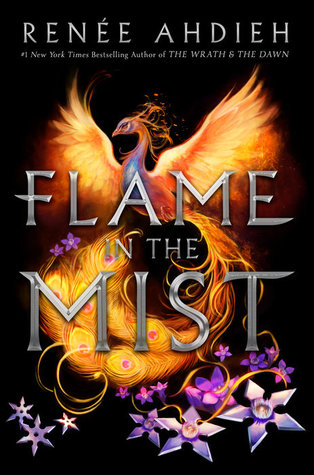
Image result for flame in the mistThe only daughter of a prominent samurai, Mariko has always known she’d been raised for one purpose and one purpose only: to marry. Never mind her cunning, which rivals that of her twin brother, Kenshin, or her skills as an accomplished alchemist. Since Mariko was not born a boy, her fate was sealed the moment she drew her first breath.

So, at just seventeen years old, Mariko is sent to the imperial palace to meet her betrothed, a man she did not choose, for the very first time. But the journey is cut short when Mariko’s convoy is viciously attacked by the Black Clan, a dangerous group of bandits who’ve been hired to kill Mariko before she reaches the palace.

The lone survivor, Mariko narrowly escapes to the woods, where she plots her revenge. Dressed as a peasant boy, she sets out to infiltrate the Black Clan and hunt down those responsible for the target on her back. Once she’s within their ranks, though, Mariko finds for the first time she’s appreciated for her intellect and abilities. She even finds herself falling in love—a love that will force her to question everything she’s ever known about her family, her purpose, and her deepest desires.

“I’ve never been angry to have been born a woman. There have been times I’ve been angry at how the world treats us, but I see being a woman as a challenge I must fight. Like being born under a stormy sky. Some people are lucky enough to be born on a bright summer’s day. Maybe we were born under clouds. No wind. No rain. Just a mountain of clouds we must climb each morning so that we may see the sun.”

I knew I would love this book from the moment I first heard about it, and I was lucky enough, back in February, to get my hands on a proof copy. It was pitched as a mix between Mulan and 47 Ronin, with a bit of Robin Hood thrown in. However, this particular story takes place in feudal Japan and focuses on samurai warriors and the seven principles of Bushido or the Way of the Warrior. Now that it is out in hard copy (yay!) I have read it once more, and can finally put my thoughts into a coherent review…

Flame in the Mist is told through two alternating perspectives: our kickass, sassy main character Mariko and her twin brother Kenshin. The story begins as Hattori Mariko is on her way to meet her betrothed for the first time – the emperor’s son. Along the way, her and her entourage are forced to travel through the dark forest or risk being late to the palace. But, the dark forest is a dangerous, deadly place, frequented by the Black Clan. Mariko’s cart is consequently attacked during the middle of the night, and she barely escapes with her life after convincingly playing dead, whilst the murderers search the rubble. What then ensues is a battle of self-preservation and survival as Mariko must make her way through the woods nearly naked, alone, and a woman. She is stalked and attacked by a homeless vagabond and she has to fight for her life, culminating in her chopping off her hair (true Mulan style) and donning the disguise of a young man who has run away from home.

She then goes on to track down her attackers in the hope of discovering why her convoy was targeted. Things, however, do not go as planned, and she soon finds herself deep within the ranks of the Black Clan, a Robin Hood/Lost Boys-esque group of warrior rebels, and her supposed killers. She must keep her true identity hidden if she ever wants to survive whilst also gaining their trust and learning their ways. Meanwhile, Mariko’s brother and brutal samurai soldier, Kenshin, is out on a mission to prove that his sister is still alive, tracking her, and getting into all sorts of fights along the way, and find the criminals responsible for attacking her.

There were some brilliant, unexpected plot-twists and action scenes in this book. The plot is intricately woven with mystery and intrigue, from the world-building to the mystical, rain drenched woodland setting, you find yourself completely submerged amongst its many folds. Ahdieh’s writing style is just beautiful. The passages of description were lyrical, whimsical, and stunningly detailed. This is the first book I have ever read that is set in feudal Japan, so I can’t speak for how historically/regionally accurate it was, but it had me believing in every essence of the world from the very start. I could almost smell the scent of oak and cherry blossoms and rainwater that Mariko lived and smelt every single day. And just as we experienced in the Wrath and the Dawn duology, the author manages to successfully and authentically include Japanese terms that only added to the tangibility of the story. (There was also a glossary in the back for times of confusion, but I soon found myself understanding the terms in context to the events.)

Mariko’s character development is probably my favourite aspect of the novel. She is often called ‘odd’ or ‘curious’, both of which she originally has an adverse and negative reaction to. She later comes to realise that these labels only make her who she is. She is sarcastic, witty, completely bad-ass and brave and she totally, wholly owns herself and her idiosyncrasies. Her confidence grows within the Black Clan, far more than it ever would have done if she had remained simply a daughter and wife, as society had mapped her future to be. She is a creator, an inventor, and a warrior, and she develops this within the Black Clan, making weapons and learning to fight. Even as she pretends to be a boy, she still remains completely feminine in the sense that she is always struggling with an internal crisis of identity – pondering the strength of being a woman and a woman’s place in the male-dominated world of feudal Japan.

The romance in the novel is also excellent. It is slow-burning, as mysterious as the world in which it is set, and you never quite truly know what is going to happen next or what the couple are really thinking. Can they be trusted? Does he really like her? Is this a game or is it real? You are never really sure, as is often the case with the ‘enemies falling in love’ zeitgeist. This varied plenty from the common star-crossed lovers’ trope though, and it is beautifully, realistically and slowly done. As well as the romance, you find yourself falling in love with the Black Clan – originally meant to be enemies – they are endearing and comical and they stole my heart.

As expected, in this book Renee is responsible for some seriously incredible world building, tangible characters, another perfectly independent kick ass heroine, and a plot so intricate you find yourself completely submerged amongst its many folds.
There is fighting and flirting, a wonderfully evasive and extremely steamy romance, a heart-stopping twist, and cleverly spun lies.

In summary, I am totally lost to this beautifully brutal world of feudal Japan. Of sharp, smart Mariko and her gutsy determination, of the shadows of the forest and the mystery of Okami and the Black Clan… I need a sequel now!

Samurais, shadows, secrets and deadly revenge… what’s not to love?!

Review – Harry Potter and the Cursed Child Script Book

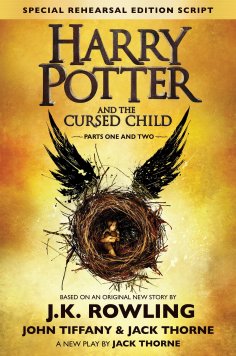
Harry_Potter_and_the_Cursed_Child_Special_Rehearsal_Edition_Book_Coverthree stars

***WARNING***

CONTAINS SPOILERS!

On Sunday morning, I awoke excitedly, with one thing, and one thing only, on my mind. HARRY POTTER.

The day felt understandably reminiscent of the publication days of the original seven books. I remember the unbound excitement, the feeling of pure, undiluted joy of holding the long-awaited next instalment in your hands, and the heart-quickening, almost panic-like, anticipation you would feel as you opened the first page, and read the first word.

In many ways, this day was just like that. There were launch events at all my local Waterstones. There were Harry Potter parties and Quidditch Tournaments and Butterbeer Pong and fancy dress events at bookshops across London. Every bookshop in the world probably had at least one beautiful display counting down the days until the ‘Eighth’ Harry Potter book. The eighth story, nineteen years later…

But unfortunately, this is where the first hurdle arises. I have tickets to see the play in September, and I have heard absolutely nothing but positive things about it. And I know it will be visually and magically stunning – I can’t wait! But reading the script I feel was a totally different experience, and not at all what I was expecting it to be.

I have read scripts, and screenplays, before, and always liked them. Some of my favourite stories are scripts! However, it was an odd and slightly bumpy experience to read Harry Potter in a script format. I have no doubt that the stage performance will be absolutely incredible (and I still can’t wait to see it in September!) but, for me, something about the story just didn’t sit right.

I read it in one sitting, which in hindsight I wish I hadn’t done. I wish I had taken more time on it – digested it slowly, appreciated it for what it was – an insight into the later lives of our beloved trio and a revisit to the Wizarding World. But even then, I don’t think I would have been that impressed.

The problem was that I was so unbelievable excited to hear from Harry, Hermione, and Ron and the rest of the Wizarding World again that I ended up being entirely disappointed. This in itself is shocking – I have never in my life been disappointed by anything Harry Potter related. But when you remember that this wasn’t singularly written by J.K. Rowling, it kind of makes sense.

I didn’t recognise the characters. I didn’t recognise Harry! His relationship with his son made me sad, which is fine – I appreciate that this was a huge part of the plot, and I did enjoy their journey as father and son and the resolution that bought them closer together. But what upset me the most was that all of the things that Harry said, to me, didn’t seem like he was himself at all. And to be honest, I’d like to think that us original Harry Potter fans know him pretty well. We lived through seven adventures with him over our entire childhood – his thoughts and experiences were ingrained into pretty much everything we did. The Harry Potter that exists in the Cursed Child just didn’t feel like my Harry. I also seriously struggled to imagine Hermione as the same person I read in the Deathly Hallows. I even found it difficult to picture Draco Malfoy. I do know that they have grown up since then. They are decades older, and have had many different experiences that we haven’t been there to witness – but there wasn’t even a smidgen of their old characterisation hidden in them. They felt like entirely new characters, and it just didn’t sit right with my idea of Harry Potter and the memories I have of the series.

I am aware this is completely based on my own interpretation of Harry as a character, and my own depiction of the Harry Potter books. Everyone views them differently, and I am sure there are many people that loved everything about this story.

I however, did not. This makes me seriously sad, and in a strange way I wish I hadn’t actually read it. Jack Thorne and John Tiffany’s writing influence was not an addition that I liked. As much as I appreciate that this is a script, and scripts in general are obviously entirely different to novels… They lack the ability to be able to set a scene and depict emotions quite so cleverly as prose does; they are in every single way, a totally different reading experience. And because of these facts, a script, to me, feels like a strange way to bring Harry’s story back to life.

My biggest issue, other than the strange re-characterisation, was the plot. God, the plot holes. There were so many! The magic lacked any authenticity. Draco Malfoy wingardium leviosa-d a character away (I mean, really?!) This is not something I was aware was even magically possible in any Harry Potter novel, ever? And then there were just many other weird things that happened, that just didn’t seem realistic to me. I didn’t recognise hardly any of the spells; I didn’t believe the fact that the Trolley Witch was just casually strolling her trolley along the roof of the Hogwarts Express with spikes for hands. And who and what the hell even was Delphini? The weakest, most insubstantial character ever created? And not forgetting the fact that the Malfoy’s were apparently in possession of a time-turner this entire time and never once used it?!

One of the things that makes Harry Potter, as a series, and as a reading experience, so incredibly great, is that the magic is ingrained in real life. J.K. Rowling’s writing was so true, so authentic, her stories and character’s so beautifully crafted, that it was always hard to imagine that none of it was real. It felt grounded in reality. Her stories were substantial, self-consistent; they followed canon; you could trust them.

This play lacks all of this, inherently. It’s too fast paced to be believable. There were too many plot twists for it to be clever; too many things that happened in too short a space of time for it to feel like a genuinely good piece of work. I’m going to reiterate what I have heard said many times – it read like a fan fiction. Sadly, truly, it did. I couldn’t see J.K. Rowling in it, anywhere.

Nineteen years later… and the magic just isn’t quite up to scratch.

IMG_2429.JPG


Book Review – We’ll Always Have Paris – Blog Tour!

9780751564570

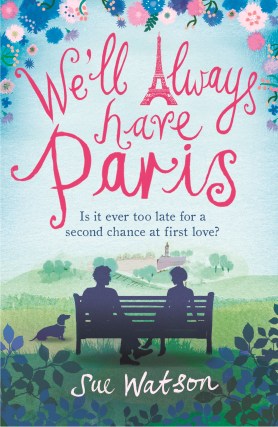
When she was almost seventeen, Rosie Draper locked eyes with a charismatic student called Peter during their first week at art college, changing the course of her life forever. Now, on the cusp of sixty-five and recently widowed, Rosie is slowly coming to terms with a new future. And after a chance encounter with Peter, forty-seven years later, they both begin to wonder ‘what if’…

Told with warmth, wit and humour, We’ll Always Have Paris is a charming, moving and uplifting novel about two people; the choices they make, the lives they lead and the love they share.

four stars


When I first got sent We’ll Always Have Paris, I wasn’t sure if I was going to enjoy it. It is definitely not my usual read, but I found myself hooked almost immediately. The characters were surprisingly relatable, and the story they told was endearing and heartwarming.

We meet the protagonist, Rosie, at the start of the story, having recently lost her husband and trying to cope with her grief and still maintain family relationships and a small part of herself. She is an extremely likeable character, who teaches us that it is never too late to realise your dreams. Through Rosie you are given an incredibly touching and truthful emotional insight into how someone copes with the loss of their loved one, and how hard, but possible, it is to fight their way through the darkness and come out the other side.

Rosie’s two daughters are also great additions to the novel; their perspectives add a second side to the grief – having lost their father, and trying to help their mother through times that they must be finding extremely difficult themselves.

Sue Watson is brilliant at writing about family dynamics – she depicts relationships between people and the emotions that they feel with incredible authenticity and sensitivity. This story includes both the bad and the good of real life, told with humour and warmth and an easy, flowing writing style that sucks you in from the first page.

I loved the hope that was prevalent throughout – the idea that we are never too old to follow our dreams, or our hearts. The romance in the book was extremely well written, and the chemistry between Rosie and her first love, Peter, is sweet, uplifting and earnest. I feel that Watson truly writes from the heart, making her novel relatable and a joy to read.

We’ll Always Have Paris is a wonderfully profound story about the loss of love, dealing with grief, family relationships, and rediscovering first love. Most prominently, it is about the importance of learning from your experiences, and the appreciation of hindsight. Through Rosie’s story, we are shown that courage is essential to living through pain, and learning to love again. Sue Watson writes with wit, warmth and a poignant understanding of human relationships and the ability that hope has to heal the heart.

We’ll Always Have Paris is out in March next year! You can pre-order it on Amazon, here.

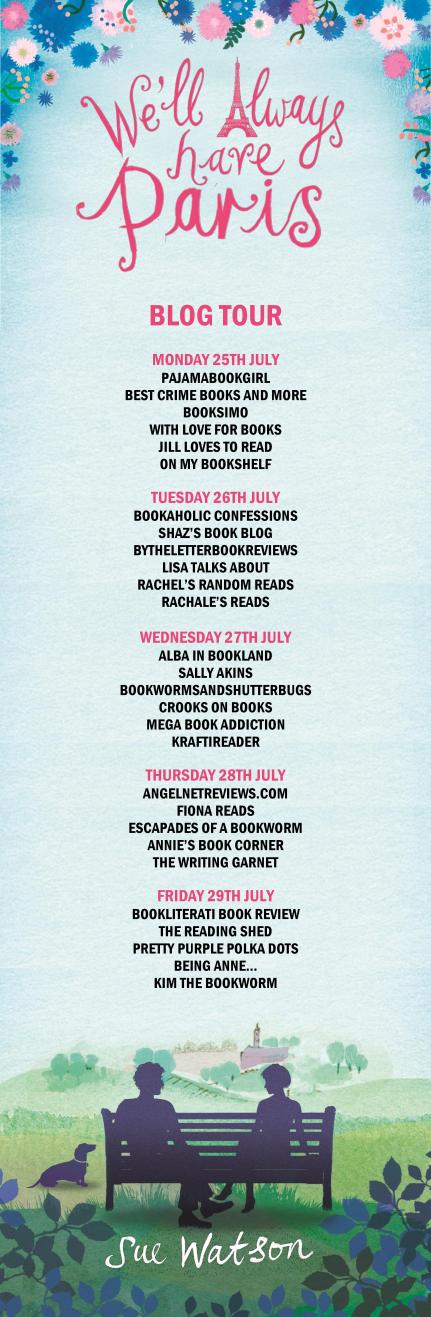
Follow the rest of the blog tour below… Next stop, Escapades of a Bookworm!

Poster-page-001 (5)

Book Review – One by Sarah Crossan

One

blue5 (2)

Grace and Tippi. Tippi and Grace. Two sisters. Two hearts. Two dreams. Two lives. But one body.

Grace and Tippi are conjoined twins, joined at the waist, defying the odds of survival for sixteen years. They share everything, and they are everything to each other. They would never imagine being apart. For them, that would be the real tragedy.

But something is happening to them. Something they hoped would never happen. And Grace doesn’t want to admit it. Not even to Tippi.

How long can they hide from the truth—how long before they must face the most impossible choice of their lives?

One is a beautiful story about 16-year-old conjoined twins, Grace and Tippi, that really got me to thinking about a way of life completely different to anything I am used to. It is a story that reveals what it means to have a soul mate – albeit not in the traditional sense of the word. The entire novel is written in beautiful, flowing verse that had me in tears and it will remain one of the most poignant stories that I have read this year.

Tippi and Grace have been by each other’s side since birth. They are conjoined from the waist down, and have lived their entire lives sharing every single moment. Having always been home-schooled, they now must attend the local private high school as juniors and face the possibility this brings of staring, disgust, ridicule and judgement.

However, they grow to enjoy normal school life more than they expected, and even make some friends. They smoke, they drink, they go on a road trip – they experience the normal teenage life they have never had the freedom to live before. The normal complications of love, boys, privacy, family drama and angst are discovered through a totally new perspective. When Grace’s health worsens and becomes life-threatening, the twins have to decide whether they wish to be separated for the first time in their lives – the outcome of which will bring a series of devastating physical, emotional and psychological impacts.

I have never read a YA book like this – it was incredibly life-affirming and powerful. I felt that it was extremely clever for Sarah Crossan to write the twin’s tale in verse, because she showed that a story can be deeply moving and hard-hitting, with just a few words. The use of verse also made the novel incredibly easy and free-flowing to read – I finished it in one sitting; in a matter of hours and I found that the words just swept you up completely in their stark, simple poetry. This way of writing created a distinctive and magically profound voice that I feel would have been impossible to replicate with normal prose.

I also found it interesting that the author chose to pen the story through only Grace’s perspective, rather than both the twins. Tippi tended to control all situations and decisions so it was effective to read the story from the shyer and less-dominant twin’s viewpoint.

In summary, Crossan has achieved a powerful, heartfelt, and deeply moving novel that explores the true meaning of the word sisters. The enormous amount of research into conjoined twins was apparent and it read as factually accurate, but also emotionally hard-hitting. It was amazing to read something that perhaps I wouldn’t normally pick up. It is the first time I have read a novel written in verse, and I am glad to say it worked perfectly. I think the writing structure contributed greatly to the meaning and significance of the story. Grace and Tippi’s is an emotionally deep tale that is all at once lovely, shocking and utterly heartbreaking.

One is like nothing I have ever read before, and is a unique and poignant exploration of friendship, sisterhood, strength, soul-mates and love.