

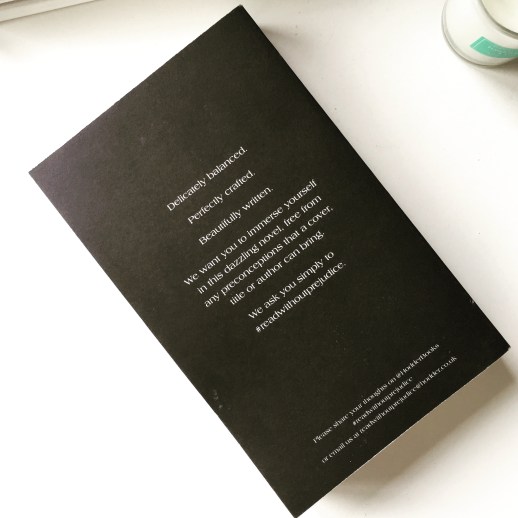
Recently, publisher Hodder & Stoughton distributed a book with no title, no cover and no author, to reviewers and publishing folk alike. The only words on the cover of the book: #ReadWithoutPrejudice. This was an incredible marketing campaign for many reasons, the most important one being that the entire message reflected that of the story inside. This book was written by an author that I have never read before, and now that I’ve finished it, I’m so glad that I was saved the preconceptions of knowing.
Ruth Jefferson is a labour and delivery nurse at a Connecticut hospital with more than twenty years’ experience. During her shift, Ruth begins a routine check-up on a newborn, only to be told a few minutes later that she’s been reassigned to another patient. The parents are white supremacists and don’t want Ruth, who is African American, to touch their child. The hospital complies with their request, but the next day, the baby goes into cardiac distress while Ruth is alone in the nursery. Does she obey orders or does she intervene?
Ruth hesitates before performing CPR and, as a result, is charged with a serious crime. Kennedy McQuarrie, a white public defender, takes her case but gives unexpected advice: Kennedy insists that mentioning race in the courtroom is not a winning strategy. Conflicted by Kennedy’s counsel, Ruth tries to keep life as normal as possible for her family—especially her teenage son—as the case becomes a media sensation. As the trial moves forward, Ruth and Kennedy must gain each other’s trust, and come to see that what they’ve been taught their whole lives about others—and themselves—might be wrong.
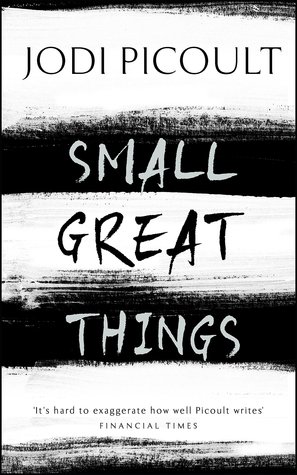
With incredible empathy, intelligence, and candour, Jodi Picoult tackles race, privilege, prejudice, justice, and compassion—and doesn’t offer easy answers. Small Great Things is a remarkable achievement from a writer at the top of her game.
 ‘It just goes to show you: every baby is born beautiful. It’s what we project on them that makes them ugly.’
This story is about so, so much. You may think you are accepting and open-minded. You may also think that you are not racist; you might think you understand white privilege and prejudice that rears its ugly head in many forms. But in Small Great Things, Jodi Picoult teaches us that there is so much more to it than we realised.
In the biggest literary risk she has ever taken, Picoult has successfully tackled an extremely sensitive and relevant topic, and has executed it beautifully. I finished this book questioning many things, specifically the way that I think about history and the way that I think about race. To understand another fully, you have to put yourself in their shoes. Jodi Picoult places us in Ruth’s shoes so brilliantly, I failed not to be touched by her life and her experiences. She was an incredible character, and I felt every heartbreak, disappointment and injustice through Picoult’s vivid and clever writing. It is a whole week since I closed the book, but I still cannot get our protagonists story out of my head.
Small Great Things was a remarkably powerful read, but hard going at times. I found it difficult to read the chapters from Turk Bauer’s point of view, but I believe this was entirely the point. Picoult has really done her research, and the novel, as a consequence, rang shockingly true and heart-breaking. She wants you to be uncomfortable; she wants you to question the blasé way racial profiling is brushed off by the courts, and she wants you to understand the way that it truly feels to be judged by the colour of your skin, rather than your talent or accomplishments. Matters such as white privilege, white supremacy, generalised racism, and the often unmentionable effects of this kind of prejudice are brought to light in a realistic, raw and cleverly crafted way.
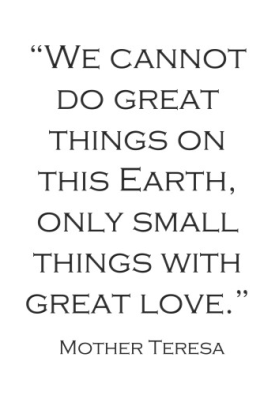 Reading this book was an incredible experience in itself – my heart was in my mouth most of the time. The story was insightful, brutally true, heart-breaking, and unjust, and uncovers the unfair and often invisible plight of many. Jodi Picoult has successfully brought to light the cause and effect behind racial profiling and the huge difference between equality and impartiality. The authenticity was outstanding and this truthful tale has left me with an entirely more informed and opened mind. This story teaches an extremely relevant lesson to never judge a book by its cover, in every sense – a mantra we should remember in the way we treat others every single day.





 Nine Lives. Four Generations. One Family. The MacEntees are no ordinary family.





 A Room of One’s Own by Virginia Woolf
 The Equality Illusion by Kat Banyard
 Sisterhood Interrupted by Deborah Siegel



 Fiona Reads