

 Series: All Souls Trilogy
Publication Date: 2011/2012/2014
Genres: Fantasy

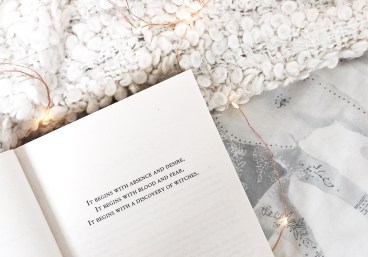
“It begins with absence and desire.
It begins with blood and fear.
It begins with a discovery of witches.”
I have just finished reading this trilogy for the second time, and surprisingly, I gleaned a lot more from it than I did the first time. I first listened to the trilogy as an audiobook, when I used to commute a long distance to work. It got me through my journeys for a couple of weeks and I enjoyed it immensely, but I do think I miss a lot from a story when I’m not able to read the words in front of me. I gain an additional level of understanding and joy from sentence structure and vocabulary – call me a nerd, I am – in a novel. Beautifully written sentences breathe life into a book.
And there is a lot of detail in these books. From spell work, to the contents of grimoires, to science and alchemy and data analysis of blood cells, it’s a massive trek through a detailed and richly tapestried world, and a insight into how biology and genealogy can change the course of your life. It is like no paranormal or fantasy book I’ve ever read. Although the world and its contents are wide, Harkness takes you through it all, and its history, in a seamless thread of intrigue, mystery, magic and desire.
Diana has distanced herself from her magical heritage, and as such, is clueless to the goings on of the witches, vampires, and daemons, hiding in plain sight around her. Her lack of knowledge enables us, the readers, to learn everything about the world gradually and authentically. The story truly starts when Diana accidentally calls a magical book, Ashmole 782, from the Bodleian Library, for her academic research. Opening the book, she realises it is an enchanted palimpsest. This action kickstarts the driving motive of the entire trilogy – also known as the Book of Origins, Ashmole 782 is coveted by all creatures, and they are all desperate to get their hands on it.
Matthew, vampire love interest (for what would a supernatural story be without a forbidden love?), is drawn to Diana because of his need for the book. He has searched for it for centuries, but when he gets to know Diana, it is no longer just the book that keeps him from pursuing her. He is a mysterious, dark, and dangerous character, with a thousand-year history full of just as many secrets. But Harkness writes him beautifully – his sincere care and feelings towards Diana flow through the plot and undercut everything that happens. There are definite parallels to be drawn here between Matthew and Diana and Jamie and Claire from Outlander – they are both relationships that travel through generations – steadfast, heady, intense, and long-lasting.
Many readers relate these books to the Twilight saga, but this trilogy is nothing like it. This is a story of the supernatural, but it is tempered by real life choices, adult dilemmas and adult relationships, and the backstory and historical science itself is enough to set it apart from any teen-vamp-drama. Harkness has a beautiful way with words, and there is a seamless flow to the books that keep you captivated. Even the scientific descriptions (and there is more than you would expect from your average fantasy novel) kept me engaged – a sign of the authors talent and ability to weave great detail into the plot without it seeming forced. Harkness is clearly very knowledgeable and has done great research into the time periods and science in the books, and this shines through, the details adding depth and connection to the characters and the story, enriching the worldbuilding and building intrigue.
The author’s research is really put to the test in the second book, Shadow of Night, as Matthew and Diana time-walk to Elizabethan England in order to hide from the creatures pursuing Diana and Ashmole 782. From the moment they step into 1591 Oxford, the newly imagined world is vividly depicted. I felt as though I could smell the ‘waxen smell’ that reminded Diana of Summer, and the ‘tang of woodsmoke’. I could practically hear the ‘crackle of a fire’, and the smell of the ‘sprigs of rosemary and lavender strewn among the rushes laid down to keep dampness from being tromped through the house.’ Even the smell of the Elizabethan smock Diana first wears is described: ‘lavender and cedar’. When she walks through London for the first time, the sights and sounds assault her, and us, in turn; ‘Bread baking. Coal fires. Wood smoke. Fermentation. Freshly washed garbage, courtesy of yesterday’s rains. Wet wool.’ Harkness’s ability to move her setting from 21st Century Madison, USA to London in 1591 is unparalleled and the time travel is unquestioned. You have no problem believing everything that is written because the worldbuilding is so richly imagined.
The All Souls trilogy has spellbound me. I especially loved the fun inclusion of Fleetwood Mac as a soundtrack to a witch’s teenage years, and the vast amount of secondary characters that all somehow held their own space within the story. With a myriad of interesting characters, deeply researched history, minutely detailed settings and a love story filled with absence and desire, Harkness has created a thought-provoking and engrossing page-turner of a trilogy. All the strands weave together in the final book to culminate in an absorbing and magical romp through science, magic, family and history. It is a story about the threads of life that tie us all together, and the discrimination and bias that can try to tear us apart.




 Fiona Reads